Mandy: The Quesnel Doll That Became a Haunted Legend
A donated doll, a disturbed workroom and a television appearance: how an ordinary museum object acquired an extraordinary reputation.
The doll and the disturbance
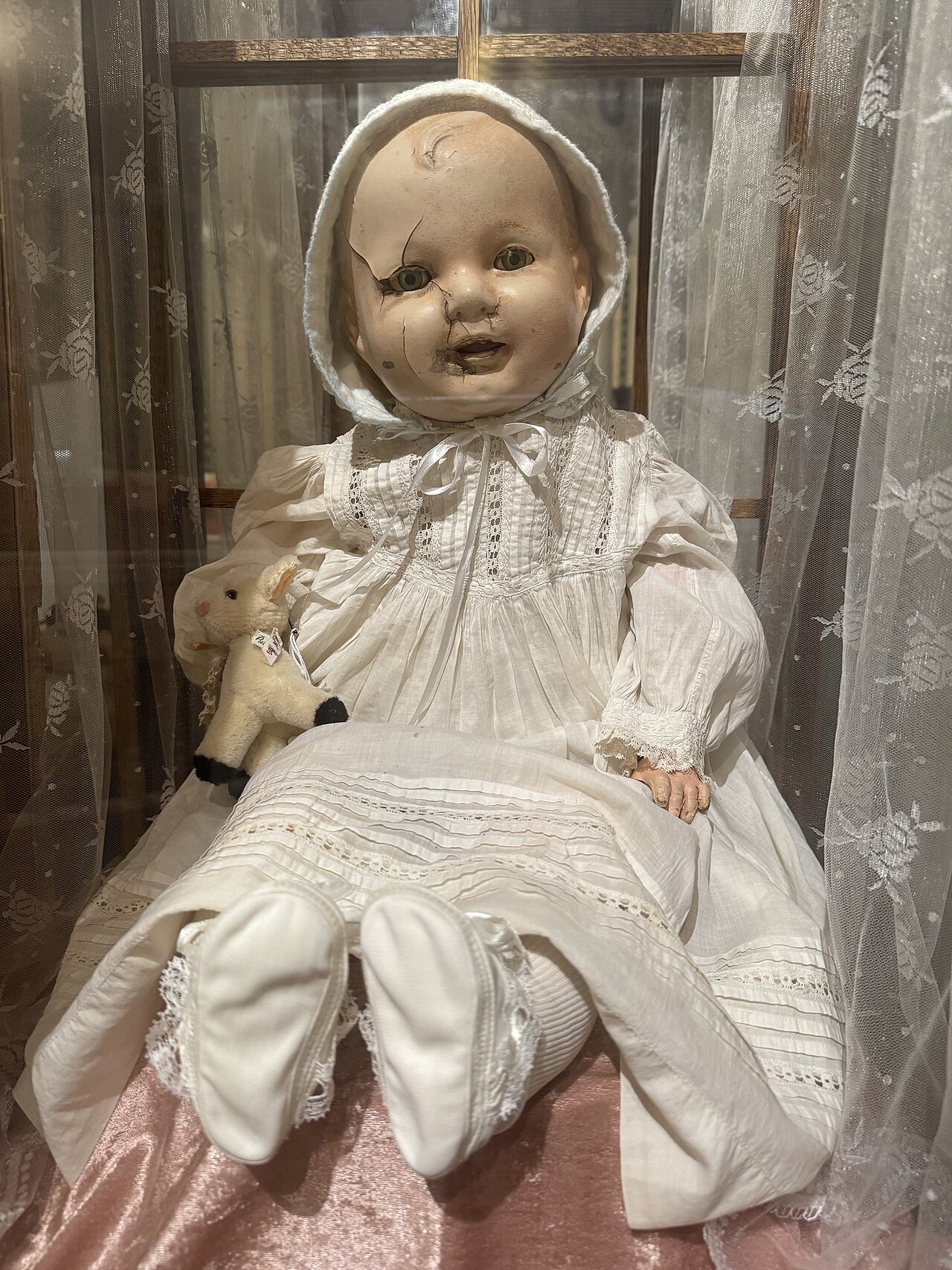
Mandy’s museum story begins with paperwork. In 1991, an old doll arrived as a donation to the Quesnel Museum. Staff photographed her for the collection, then left her in a workroom overnight. According to the museum’s account, they returned to find things in disorder. The scene was compared to a child’s tantrum. A routine accession had acquired a second story.
Another account involved Mandy’s stuffed lamb, reportedly found outside a locked display case. These are stories the museum preserves alongside the doll. They are not proof that the doll moved anything. Yet their appeal is easy to understand: the supposedly active figure is a toy, and the setting is a room devoted to keeping objects safely in place.
Sources: 1
A face with a history
Even Mandy’s material is sometimes misidentified. In a 2024 interview with the Quesnel Observer, museum and heritage manager Elizabeth Hunter described a composition doll, probably made in the late 1920s or early 1930s. Composition used ingredients such as sawdust or wood flour with glue, formed and finished with paint. Mandy is not a porcelain doll.
Hunter also described a modest family handover. A grandmother had kept the doll in a trunk and passed it to her granddaughter, who had a new baby. The granddaughter did not want the old doll around her child and gave it to the museum. This prosaic beginning is part of Mandy’s appeal. A family possession became something strangers travelled to see.
Sources: 2
The trip to television
In April 1999, the museum says, Mandy travelled to New York for the Montel Williams Show. A small-city collection now had an object with a television career. The doll did not need to change for her audience to grow; the stories could do the travelling for her.
Sources: 1
What the keeper of the doll says
Hunter told the Observer that she had not personally had a spooky experience with Mandy. She also said the television psychic’s story about the doll could not be connected to the donating family. That distinction leaves room to enjoy the legend without replacing provenance with a performance.
Sources: 2
Look beyond the glass
A museum visit offers something an online ghost story cannot: the actual object among the other things a community has kept. The Quesnel Museum stands on the traditional territory of the Lhtako Dene. Its displays include Chinese gold-rush artifacts, photographs by C.D. Hoy and C.S. Wing, and recordings through which visitors can hear Chinese and First Nations Elders.
Give those exhibits time too. A famous doll can bring someone through the door; photographs, voices and ordinary possessions can make the town around that door more legible. The haunting is only one way an object gathers a story.
Sources: 3
Meet Mandy on museum time
Use the museum’s current hours and admission page when planning a visit, especially outside summer. Mandy is a museum exhibit, not an invitation to enter after closing. Follow the display’s photography instructions and leave the case and its contents alone.
Mandy is a compelling reminder that a small museum can hold an object with a much larger life in the imagination. Stay long enough for the quieter exhibits to have their turn.
Sources: 4
Sources and further reading
- Mandy (opens original source)Quesnel & District Museum and Archives · Checked
- Quesnel’s most popular haunted doll (opens original source)Quesnel Cariboo Observer, Austin Kelly, 31 October 2024 · Checked
- Quesnel & District Museum and Archives (opens original source)Quesnel & District Museum and Archives · Checked
- Hours and Admissions (opens original source)Quesnel & District Museum and Archives · Checked