Why Is There a Rainforest Near Prince George?
Giant cedars beside Highway 16 tell a story about snow, groundwater and the surprisingly wet side of the Interior.
The forest that challenges the map in your head
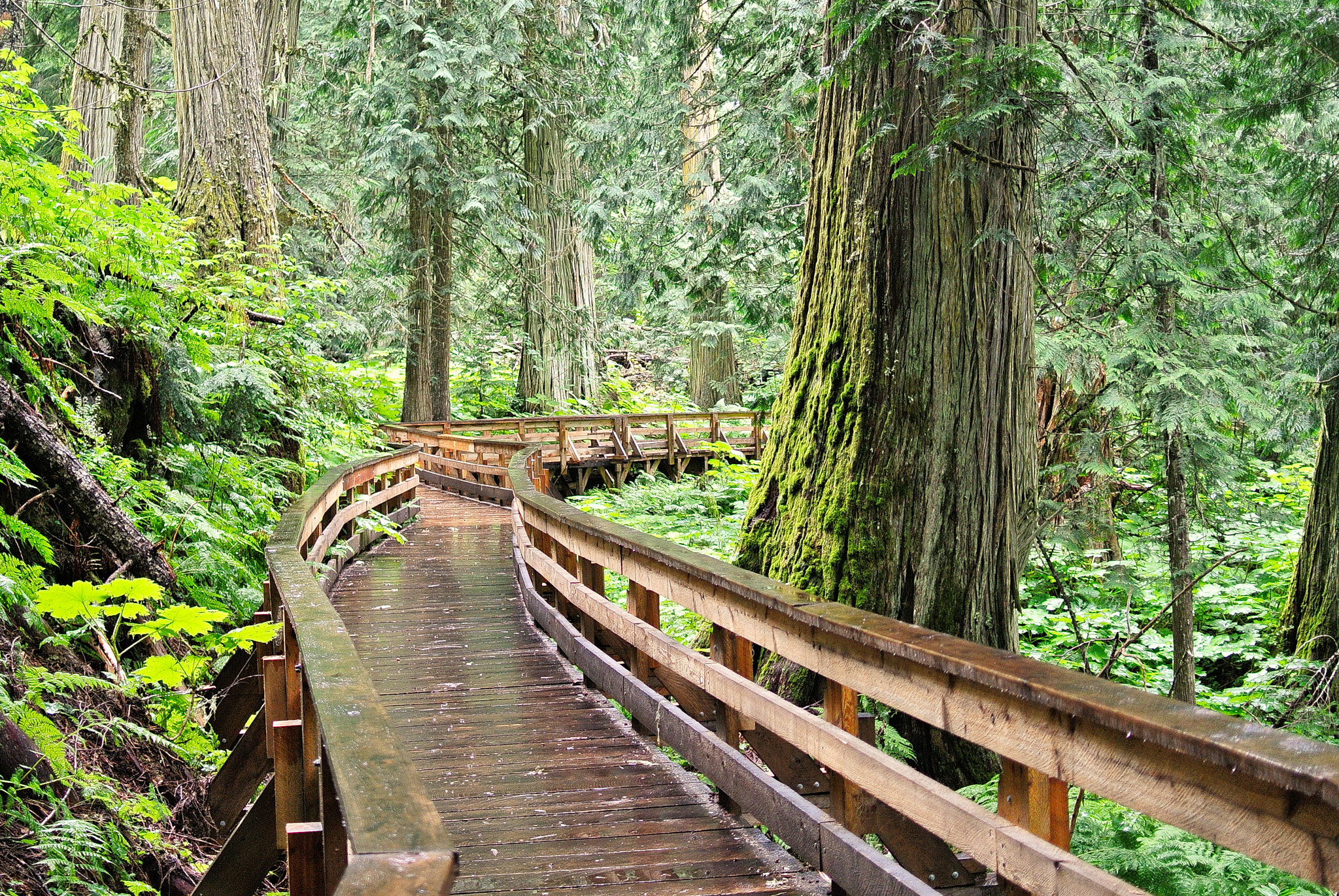
Rainforest often brings to mind the coast: ocean air, island inlets and rain moving in from the Pacific. East of Prince George, the great cedars of Ancient Forest / Chun T’oh Whudujut offer another version. The park sits beside Highway 16, inland between Prince George and McBride, in a landscape where winter snow is an essential part of the story.
The surprise is not simply that large trees grow here. It is that an inland climate can sustain the moisture conditions associated with a temperate rainforest. Understanding that makes the walk more interesting. The boardwalk is a way into a water system as much as a collection of impressive trunks.
Winter stores some of the water
BC Parks' management-planning background describes this as a snow forest. Deep winter snow helps sustain groundwater springs through the rest of the year. Snowfall therefore matters beyond the months when it covers the trail: it is part of the supply that keeps the forest wet later.
The useful idea is delayed delivery. Precipitation arriving in winter can remain stored as snow before melting and moving through the ground. That does not mean every cedar is fed by one visible spring, or that summer rain is irrelevant. It means the forest's water story cannot be read from a rainy afternoon alone. A winter landscape and a green summer understory belong to the same system.
Sources: 2
The wet Interior has its own research story
UNBC researchers have spent years studying this forest and the surrounding inland wetbelt. Lichen biodiversity research helped draw wider attention to the large cedar stands, and later work examined the area's microclimate, ecological value and conservation. Those small organisms are an important part of why researchers were looking carefully in the first place.
A University account from 2007 records Dave Radies describing the heavy snowfall and unusually large, old cedars he encountered during his research. It is a useful historical perspective, provided it is read as research history rather than a claim that the forest was previously unknown to everyone. The land has a much longer relationship with the Lheidli T’enneh.
Let the small things compete with the big trees
The biggest cedars are an obvious focus for a first visit. BC Parks describes a forest rich in mosses, lichens, fungi and other plants as well. Slowing down changes the scale of the walk: a trunk, a shaded hollow and a small patch of bark can each hold something worth looking at.
The age of the larger trees adds another scale to the scene. Some are described by the park and researchers as potentially more than a thousand years old. Stand where the path allows a clear view of a trunk and look upward: the photograph that includes the surrounding forest may say more about that scale than a close crop of bark. Exact birthdays are not needed to appreciate a tree that has outlasted so many human generations.
A living place with living stewardship
Ancient Forest / Chun T’oh Whudujut lies within Lheidli T’enneh territory. The Nation's enhancement project sets out plans for improved visitor access and cultural interpretation, alongside work on boardwalks and other facilities. The forest's significance extends beyond an unusual ecosystem or a roadside attraction.
Cultural interpretation can change what a visitor notices just as surely as a lesson in ecology. The Nation’s own project information is the starting point for learning about that work. As access and facilities evolve, follow the posted directions and open routes. A return visit may offer new ways to understand a place whose importance has never been limited to the age of its trees.
A slower way to look at a forest
Leave room in the day for a second look. After the largest trees have drawn you in, choose a smaller scene beside the path: the surface of a fallen trunk, a shaded patch of bark or the way green growth fills a gap. The scale of the forest changes when the subject is small enough to fit in your hand but is left exactly where it belongs.
Check the park and Lheidli T’enneh notices when planning your visit, then give the place your attention. Its story reaches from winter snow to summer shade, from the crown of a cedar to life on its bark, and from a visitor’s brief walk to generations of stewardship. You can leave with a photograph of a great tree and a more interesting idea of what a forest is.
Explore the places in this story
Ancient Forest guide
Forest and waterfall route is distinct from the universal-access section.
Universal-access boardwalk
A separately described route; current surface and construction access still need checking.
Sources and further reading
- Ancient Forest / Chun T’oh Whudujut Protected Area (opens original source)BC Parks · Checked
- Planning for Ancient Forest / Chun T’oh Whudujut and Slim Creek Parks (opens original source)BC Parks and Lheidli T’enneh planning partnership · Checked
- Converging Interests: The Value of an Ancient Forest (opens original source)University of Northern British Columbia · Checked
- Ancient Forest Highlighted in Green Day Celebration (opens original source)University of Northern British Columbia · Checked
- Ancient Forest Enhancement Project (opens original source)Lheidli T’enneh First Nation · Checked