The Crow That Remembers Your Face
Researchers changed their clothes, their walk and even the person wearing the mask. The crows still knew which face meant trouble.
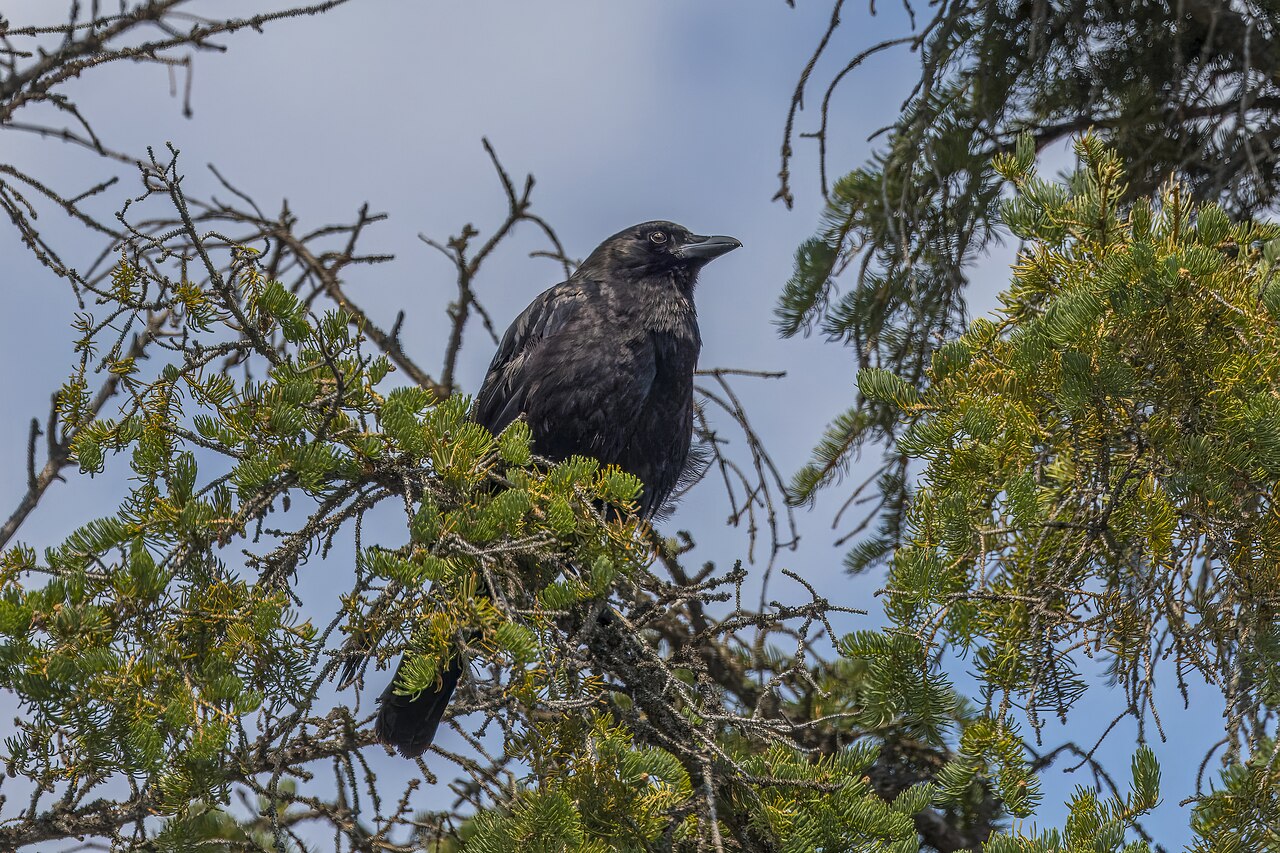
The bird in the ordinary landscape
An American crow does not need remote wilderness to lead a complicated life. It feeds in open areas, uses towns and woodlands, and can belong to a family whose young help raise later broods.
The black shape on the grass belongs to an individual moving among other individuals, food sources and recurring encounters. For a crow living around people, which human has appeared can matter as much as the fact that a human is there.
Sources: 1
A face you could take off
Near Seattle, researchers put on masks while trapping, banding and releasing wild American crows. Later, people walked through the study areas wearing the same faces. The crows responded with harsh calls and sometimes gathered to mob the wearers.
The remarkable detail was the substitution. People of different heights, ages and genders, with different walking styles, could wear the threatening mask and receive the response. The remembered feature travelled with the face. A neutral mask, or an unmasked trapper, generally received far less attention.
The 2010 study reported recognition lasting at least 2.7 years. This was not simply a crow reacting to an alarming shape the first time it appeared. An encounter had given that shape a history, and the birds continued to respond to it.
Sources: 2
The bird that never met the trapper
Then the story spread. Follow-up research found that crows could acquire the response socially, including young birds learning from their parents. Some birds that had never been trapped later scolded the dangerous mask on their own.
That last detail matters: joining a noisy group is different from subsequently recognizing the same face without the group. The observations supported learning that endured beyond the immediate commotion. At the long-term University of Washington site, responses expanded over time and distance as opportunities to observe other birds accumulated.
A person's reputation, in the limited but meaningful sense of a learned danger association, could therefore outgrow that person's direct encounters. A crow did not always have to pay the cost of being captured to learn which face warranted caution.
Sources: 3
A face can also mean care
Recognition was not confined to threats. In a brain-imaging experiment, crows encountered faces associated with capture or with caretaking. The researchers measured activity while the birds viewed these familiar faces and found different patterns linked to their different histories.
Threat-associated faces engaged circuitry involved in fear and attention. Caring faces produced a different response involving motivation-related regions. The birds were combining what they saw with what previous experience had made that sight mean.
The experimental faces themselves were not displaying helpful smiles or threatening scowls. Their significance came from the encounters attached to them. That makes the finding more personal, and more precise, than a general claim that crows find people frightening: a familiar face could carry a particular expectation.
Sources: 4
What a dead crow can teach
Another Washington study tested a darker route into that memory. People were presented alongside a dead crow, a red-tailed hawk, or a hawk with a dead crow. Afterwards, wild crows could recognize and scold the associated human, with the learned response still detectable six weeks after a single training event.
The birds also became more reluctant to approach food where these events had occurred. The dead bird had become information about a place and a possible threat. A gathering around a carcass could be part of learning what to avoid.
Those results do not give direct access to a crow's feelings about death. They reveal something observable and consequential: an encounter can alter how the survivors treat both the location and a face connected with it.
Sources: 5
An ordinary neighbour, newly noticed
The crow returns to foraging, family and other birds. That everyday life makes the experiments compelling. Learning about people can fit into the practical business of living beside them.
There is no need to provoke a response to make the idea interesting. The next familiar black bird can remain undisturbed. The change belongs to the observer: a creature once dismissed as scenery may have a much more particular view of the people passing through.
Sources: 1
Sources and further reading
- American Crow Overview (opens original source)Cornell Lab of Ornithology · Checked
- Lasting recognition of threatening people by wild American crows (opens original source)Marzluff and colleagues, Animal Behaviour, 2010 · Checked
- Social learning spreads knowledge about dangerous humans among American crows (opens original source)Cornell, Marzluff and Pecoraro, Proceedings of the Royal Society B, 2012 · Checked
- Brain imaging reveals neuronal circuitry underlying the crow's perception of human faces (opens original source)Marzluff and colleagues, PNAS, 2012 · Checked
- Wild American crows gather around their dead to learn about danger (opens original source)Swift and Marzluff, Animal Behaviour, 2015 · Checked