Why the Trees Seem to Watch You: Faces, Shadows and the Human Brain
Two knots and a split in the bark can become a face before you have time to decide what you are looking at. The strange part is how much of your brain believes the first impression.
The face arrives first
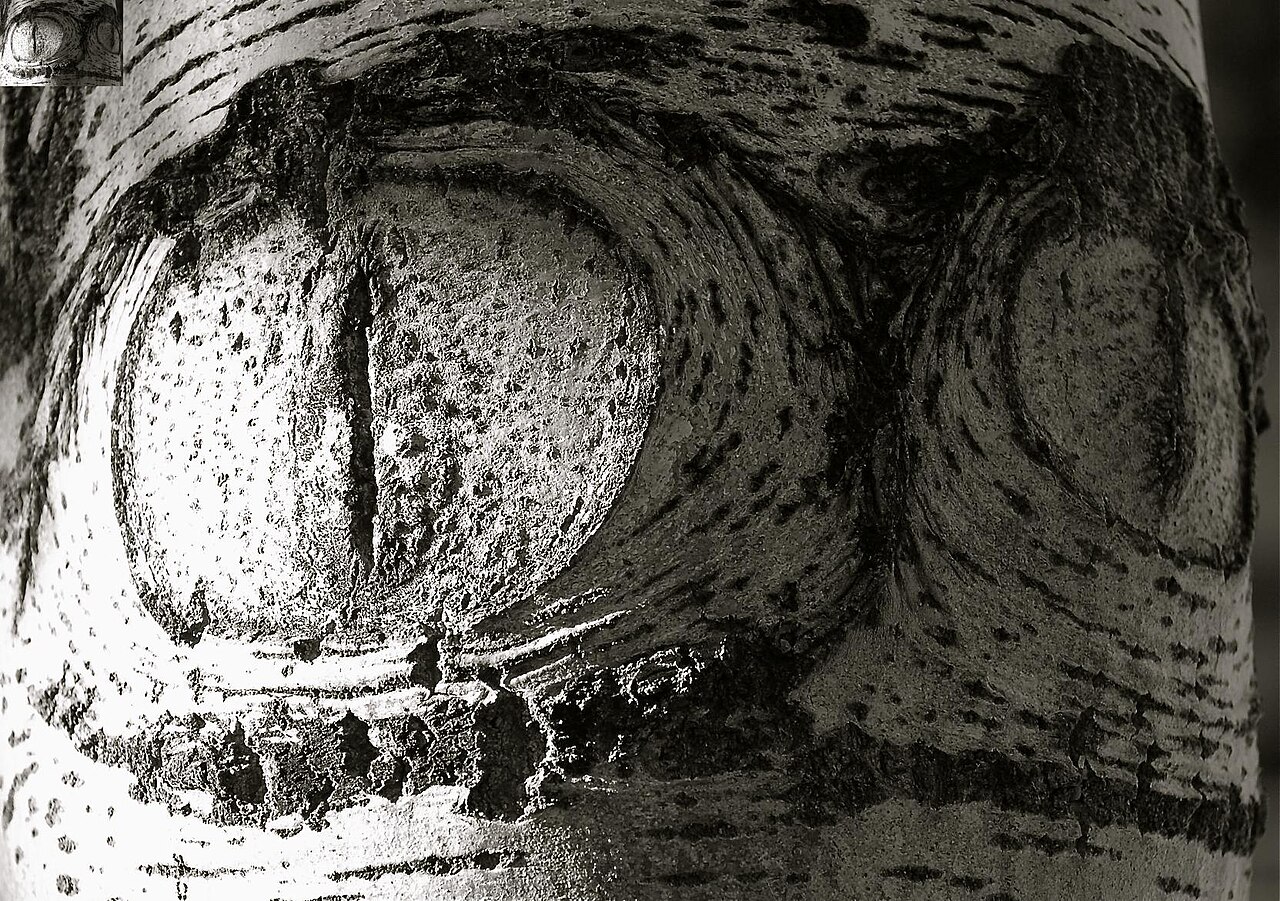
Two dark knots sit above a crack in a tree trunk. You know what they are, yet the arrangement seems to look back. Shift your attention and the crack becomes a mouth. It may even seem annoyed.
This familiar experience has a name: face pareidolia. The brain finds a face in something that is not one. A loose arrangement of features can be enough, and recognizing the mistake does not necessarily erase the impression. Bark can remain bark while also looking like a face. The ordinary object and the startling interpretation occupy the same moment.
Sources: 1
Too quick to be a ghost story
A 2020 study combined brain-imaging methods to investigate how this happens. Researchers presented photographs of objects with illusory faces, ordinary objects and real faces. The brain's response to face-like objects initially shared features with its response to human faces, then became more object-like as processing continued.
The sequence helps explain the peculiar double take. A face-like arrangement can engage face processing rapidly, while the fuller account of what the object is develops around it. The experience does not require a long spell of staring or a deliberate decision to imagine someone in the tree. Recognition can begin before the bark has finished being merely bark.
Sources: 2
Why does that stump look angry?
The illusion often comes with an expression. A knothole face may seem cheerful, worried or cross, even though the wood has no feelings to communicate. Researchers tested this extra layer by asking people to judge expressions in photographs of real faces and face-like objects.
A preceding image influenced how the next expression was judged. That carryover occurred between human faces and illusory ones, supporting the idea that shared perceptual mechanisms help assign expression to both. The brain is doing more than matching a crude diagram of eyes and mouth. It can place the resulting pattern on an emotional scale, lending a fallen branch a remarkably specific attitude.
Sources: 3
A face response inside the brain
A later study approached the question through electrodes already implanted for the medical care of 44 patients. In recordings from visual areas, face-like objects activated much of the same network that responded selectively to human faces. The response was generally weaker for the objects, but its spatial overlap and early timing were striking.
This does not mean a face in a tree is indistinguishable from another person. The difference in response matters. It does show that the resemblance can reach into the machinery used to process actual faces, rather than remaining only a story added afterwards. The apparent watcher has a real counterpart in the viewer's neural activity.
Sources: 4
What you notice depends on what you are doing
That sensitivity is not an irresistible alarm that fires whenever a face-shaped patch enters view. In a series of visual-search experiments, researchers found that distracting real and illusory faces did not automatically capture attention when participants were searching for butterflies. When each category became a search target, real faces were detected more efficiently than illusory faces or butterflies.
Attention has a job, and the job matters. This is useful context for the everyday experience: a person looking for a trail marker and a person studying patterns in bark are approaching the scene differently. The experiments were controlled image tasks, but they challenge the tempting idea that every accidental face must command every viewer.
Sources: 5
Sometimes a face really was put there
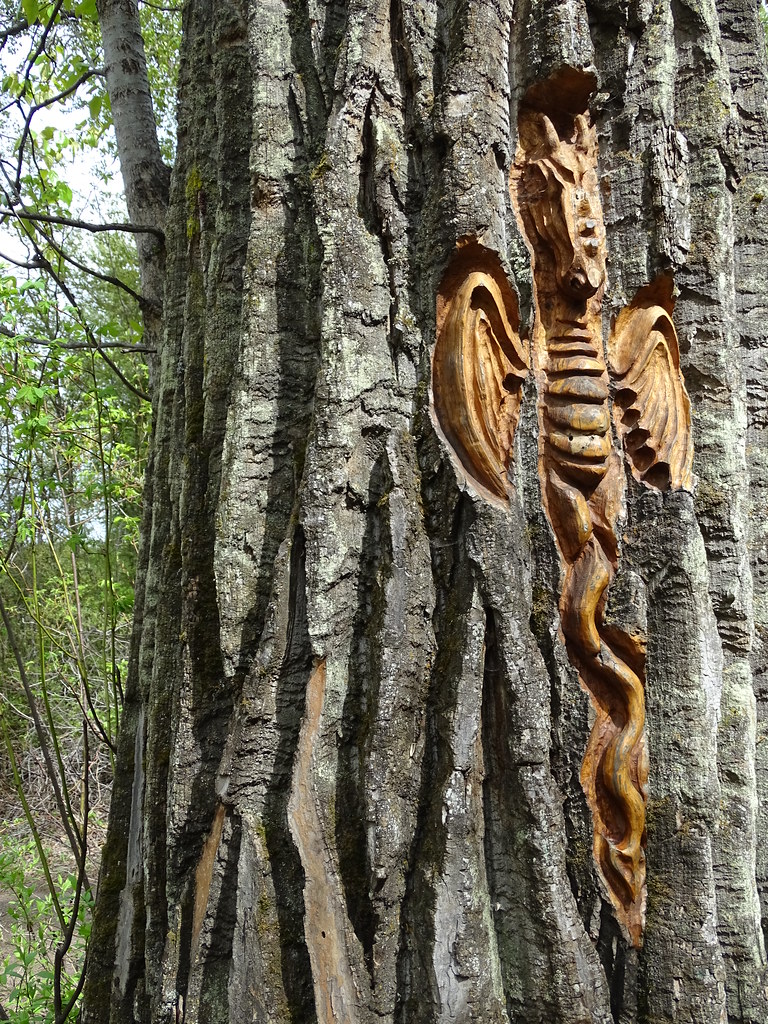
The City identifies Elmer Gunderson's bark carvings among Cottonwood Island's features. Those faces are intentional artwork. Nature's accidental arrangements and an artist's deliberate ones deserve different stories.
Sources: 6
Knowing does not spoil it
A knot does not become less expressive because the mechanism has a name. The pleasure is holding both interpretations at once: a piece of wood and the appearance of a face. The watcher is an encounter between the pattern on the tree and a mind unusually good at finding company.
Sources: 1
Explore the places in this story
Cottonwood Island Nature Park
An intentional bark-carving comparison, not a claim that its sculptures are examples of natural pareidolia.
Sources and further reading
- Why our brains see human faces everywhere (opens original source)University of Sydney · Checked
- Rapid and dynamic processing of face pareidolia in the human brain (opens original source)Wardle and colleagues, Nature Communications, 2020 · Checked
- A shared mechanism for facial expression in human faces and face pareidolia (opens original source)Alais and colleagues, Proceedings of the Royal Society B, 2021 · Checked
- The neural basis of face pareidolia with human intracerebral recordings (opens original source)Cerrahoglu and colleagues, Imaging Neuroscience, 2025 · Checked
- Attentional capture by real and illusory faces: a failure to replicate (opens original source)Miti and colleagues, Psychological Research, 2025 · Checked
- Cottonwood Island Nature Park (opens original source)City of Prince George · Checked