Fairy Rings: Who Drew Those Circles in the Grass?
A circle of mushrooms looks arranged, almost deliberate. Under the grass, a slow-moving organism has been drawing the pattern for far longer than the mushrooms have been visible.
The circle that seems to have an author
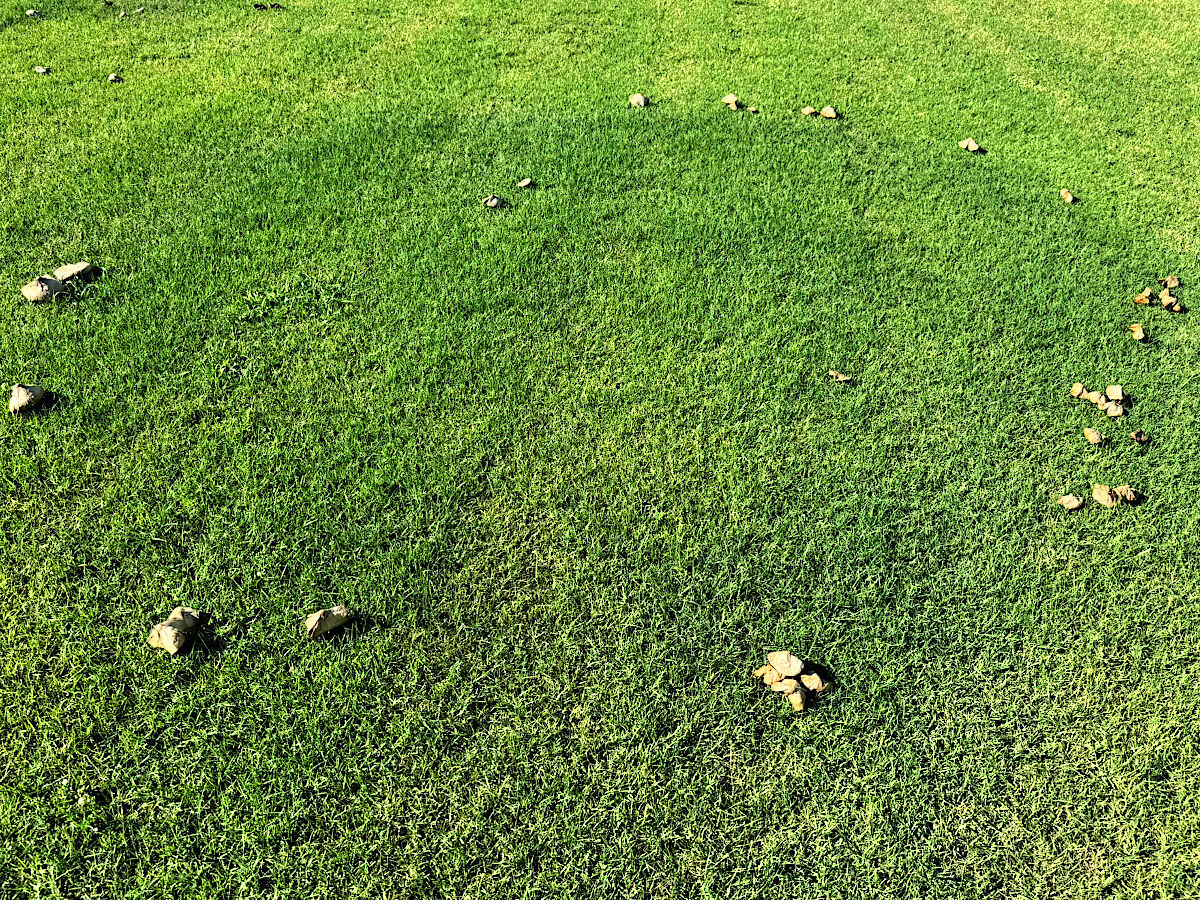
A scattered mushroom is easy to accept. A row of them making a circle feels different. The repetition suggests someone has laid them out, leaving a pattern neat enough to invite a story.
The author is below ground. Fairy rings are made by fungi living through the soil, where they break down organic material. Their mushrooms are a temporary display of a much larger, less visible presence. What looks like an overnight arrangement can reveal a process that has been unfolding beneath the grass for years.
Sources: 1
An edge moving outward
In a typical ring, fungal threads spread outward from an earlier centre. As the colony advances, older growth can die back behind it. The active edge becomes a roughly circular front, and mushrooms emerge along that front when conditions suit them.
The geometry follows the growth. A circle is what outward expansion can produce when no direction has a decisive advantage. It does not require the fungus to know the shape it is drawing. Nor does a ring of separate caps necessarily represent a collection of separate organisms: the important connections lie in the mycelium, the fine network occupying the ground below.
Sources: 2
Why the grass changes colour
Sometimes the grass gives the fungus away before any mushrooms appear. A greener band can form where decomposition releases nutrients, including nitrogen, into the soil. Buried roots, old stumps and other organic remains can provide food for the fungi involved.
That makes the ring a map of activity rather than simply a line of mushrooms. The lawn may be uniform to the eye, while its underground history is anything but uniform. A vanished root or buried woody remnant can still contribute to what grows above it. In cool, wet conditions, fruiting bodies may make the same patch's fungal presence much more obvious.
Sources: 3
A circle can break without losing its meaning
Many rings are arcs, interrupted curves or imperfect loops. The Burke Herbarium's account of the fairy ring mushroom explains that uneven soil or obstructions can interrupt outward growth. The incomplete shape is still a trace of the same process.
A circle also fails as a shortcut to identification. Marasmius oreades is one familiar ring-forming mushroom, but other species can draw similar patterns. The herbarium specifically notes a poisonous lookalike that can also grow in rings. A neat circle is evidence of how a fungus is growing, not evidence that its mushrooms are safe to eat. The geometry cannot answer a species-level question.
Sources: 4
The warning remembered in Wales
The name carries an older explanation. In his 1880 collection British Goblins, Wirt Sikes described Welsh beliefs that fairies had made circles in grass through dancing. He recorded meeting an older man at Peterstone-super-Ely who remembered his mother's warning to stay out of them and said he had never entered one.
That remembered instruction gives the folklore a human scale. The ring did not need a visible dancer to influence somebody's route through a field. A childhood warning could last into old age. This is a documented Welsh tradition, part of the history of the English name, rather than a story attributed to the peoples of northern British Columbia.
Sources: 5
An older organism than the mushrooms suggest
The fruiting bodies can be brief appearances in a long life. Kew's account of ring-forming fungi notes that some large rings may be decades or even centuries old. Their size records continued outward growth, although a ring's diameter alone does not provide a reliable birthday without knowing its history and growth rate.
That contrast is part of the attraction. The mushrooms can look fresh and delicate while the organism making them has persisted through many seasons. When the caps collapse, the familiar landmark may vanish from view. Its disappearance above ground need not mark the end of the fungus below.
Sources: 6
The drawing is still in progress
A fairy ring turns ordinary grass into a record of decomposition and growth. A partial curve can be as revealing as a perfect circle.
Something alive has made a pattern without a hand, a ruler or an intention to impress us. For a little while, the surface shows where the underground work has reached.
Sources: 1
Sources and further reading
- Mushroom Fairy Rings (opens original source)Oregon State University · Checked
- Fairy rings (opens original source)Royal Horticultural Society · Checked
- Fairy Rings in Lawns (opens original source)South Dakota State University Extension · Checked
- Marasmius oreades (opens original source)Burke Herbarium, University of Washington · Checked
- British Goblins: Welsh Folk-lore, Fairy Mythology, Legends and Traditions, Chapter VIII (opens original source)Wirt Sikes, 1880; Project Gutenberg edition · Checked
- Discovering Fungi (opens original source)Peter Marren, Kew magazine, Autumn 2018 · Checked