When Rotten Wood Glows: The Science Behind Foxfire
Some fungi can turn decaying wood into a source of light. The chemistry is real, but the reason for the glow is a more complicated mystery.
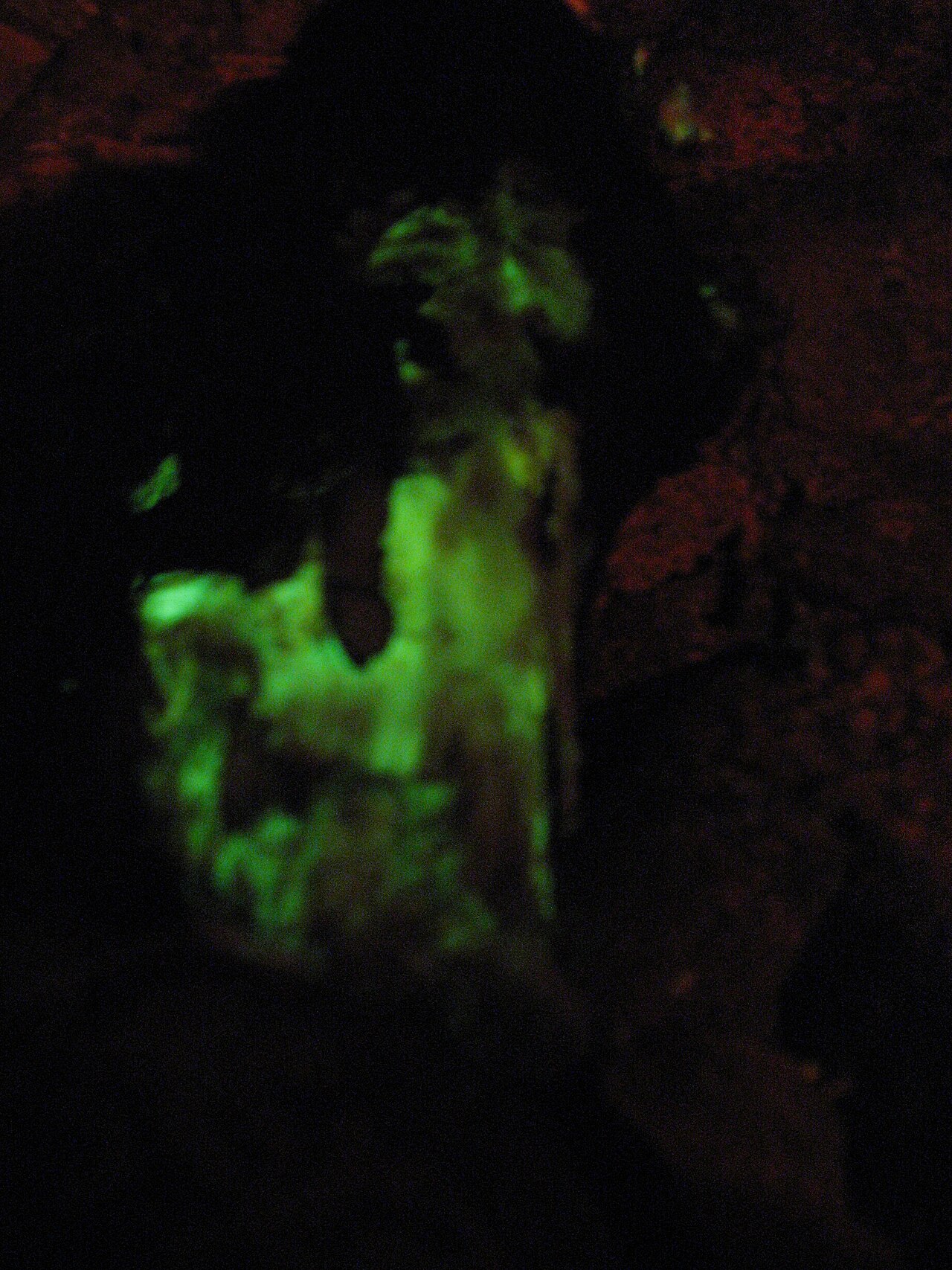
Light with no lamp behind it
The unsettling idea is not a light moving between the trees. It is the wood itself giving off light. Foxfire is the name for a glow associated with certain fungi growing in decaying wood, one of the places where an apparently ordinary forest object can become luminous.
This is bioluminescence: light produced by a chemical reaction within a living organism. It does not need a flashlight beam to bounce back toward the observer. The source is alive inside or upon material that is already dead.
Sources: 1
A chemical circuit for making light
Research published in 2018 identified key components of the fungal light-producing system, including the enzyme luciferase and the machinery for making its light-producing substrate. The pathway draws on caffeic acid, a compound involved in plant and fungal chemistry. A series of reactions supplies the material that luciferase uses to generate the glow.
The researchers transferred the necessary genes into yeast, which then produced light. That experiment took the phenomenon beyond a curious photograph of a mushroom. It showed that a defined biological system could carry the capacity into another organism.
The word luciferase describes a light-producing enzyme, not a single universal recipe for all glowing life. The fungal system has its own chemical machinery. Its pale light is the visible output of metabolism.
Sources: 2
The mushroom may not be the glowing part
A photograph of luminous mushroom caps can give the wrong impression of foxfire. In some fungi, the glow belongs mainly to the mycelium, the network of threads that grows through its food. The obvious mushroom and the less visible organism beneath it need not shine in the same way.
A study of three North American Armillaria and Desarmillaria species followed light production as the fungi developed from mycelium into mushrooms. The researchers found luminous mycelia, while mature fruiting bodies produced little appreciable light. Brightness declined sharply during development.
That distinction changes what glowing wood means. A log can contain light-producing fungal tissue without supporting a display of shining caps. The wood is a home and food source; the living network within it is doing the luminous work.
Sources: 3
The Brazilian experiment with artificial mushrooms
Why spend energy making light? In Brazil, researchers studying Neonothopanus gardneri found a daily rhythm in its glow that persisted under constant darkness. They then tested a possible ecological role using an unusual set of forest props: artificial mushrooms fitted with green lights.
In field trials in Piaui, illuminated models attracted more arthropods than unlit controls. The result supported an appealing possibility: visitors drawn to the glow might help carry spores. Light could make a mushroom more noticeable to potential dispersers in the darkness.
The experiment measured attraction, not the complete journey from a spore leaving one mushroom to establishing a new fungus. It offers evidence for a dispersal hypothesis in a Brazilian species, rather than a single proven purpose for every luminous fungus. The artificial mushrooms made one part of that otherwise difficult story testable.
Sources: 4
A glow is a condition, not a guarantee
Light production can change with the organism's circumstances. Laboratory research on Omphalotus guepiniiformis examined how temperature and other stresses affected its glow and the activity of associated genes. Some treatments reduced luminescence, while wounding could increase it under the tested conditions.
Those results reveal a responsive living process. They do not make disturbing a wild fungus a way to improve a photograph. Species, tissue, development and conditions all matter, so the presence of rotting wood alone is no promise of visible light. The brilliant images circulated online often show a particular organism under carefully chosen conditions, not the ordinary appearance of every damp log after sunset.
Sources: 5
The living part of a dead tree
Foxfire makes a familiar distinction unstable: dead wood can contain living things, and those living things can produce their own light. Its scientific explanation does not make that any less strange. The glow is neither a reflection nor an ember. It is an organism turning part of its chemistry into something visible, a faint signal from the life continuing inside decay.
Sources: 1
Sources and further reading
- The Bioluminescence Web Page (opens original source)University of California, Santa Barbara researchers · Checked
- Genetically encodable bioluminescent system from fungi (opens original source)Kotlobay and colleagues, PNAS, 2018 · Checked
- Bioluminescence expression during the transition from mycelium to mushroom in three North American Armillaria and Desarmillaria species (opens original source)Mihail, Bilyeu and Lalk, Fungal Biology, 2018 · Checked
- Circadian Control Sheds Light on Fungal Bioluminescence (opens original source)Oliveira and colleagues, Current Biology, 2015 · Checked
- Cloning and Expression Analysis of Bioluminescence Genes in Omphalotus guepiniiformis Reveal Stress-Dependent Regulation of Bioluminescence (opens original source)Park and colleagues, Mycobiology, 2024 · Checked