When the Fraser Was the Highway: Seeing Prince George’s Riverfront Through Its Past
A shop painted to catch passing boats, a house above the landing and a river that once set the direction of a journey.
A storefront aimed at the water
The general store at Huble Homestead was designed to catch the eye of someone arriving on the Fraser. The original false-front building faced the river and was painted white. It advertised itself to boat passengers, railway construction crews, prospectors and families moving through the country. Imagine choosing the front of a shop by the direction of passing boats: the riverfront immediately becomes a different kind of street.
That is the useful change of perspective to bring to Prince George’s waterfront. A riverside path may now be where you go to slow down. For much of the region’s history, the water beside it was how people got somewhere.
Sources: 1
Begin with the confluence
The Lheidli T’enneh name connects the Nation with the meeting of the Nechako and Fraser. These rivers supported travel, fishing and relationships long before a steam engine arrived. At Lheidli T’enneh Memorial Park, the village history and cemetery give that connection a particular place within the modern city.
The city’s railway-era growth also involved dispossession. Remaining residents were forced from the Lheidli village in 1913 and the village was burned. A waterfront history that includes only the arrival of boats and trains misses what that development cost the people already living here. Visit the park’s interpretation and Hodul’eh-a at The Exploration Place alongside the transport story.
A house above a former arrival point
In South Fort George, the Howieson Residence survives from 1912. Its heritage statement places it above the Fraser near where sternwheelers docked when the neighbourhood was being built. William Howieson, a cabinetmaker and finish carpenter, built the house himself. His work also appeared in other local buildings.
The house is a private property, best understood from the public street and the city’s heritage records. Its setting is the telling detail. The nearby river was an arrival point, and a home overlooking it belonged to a working settlement whose connections faced the water. Today’s street view can hide that older orientation.
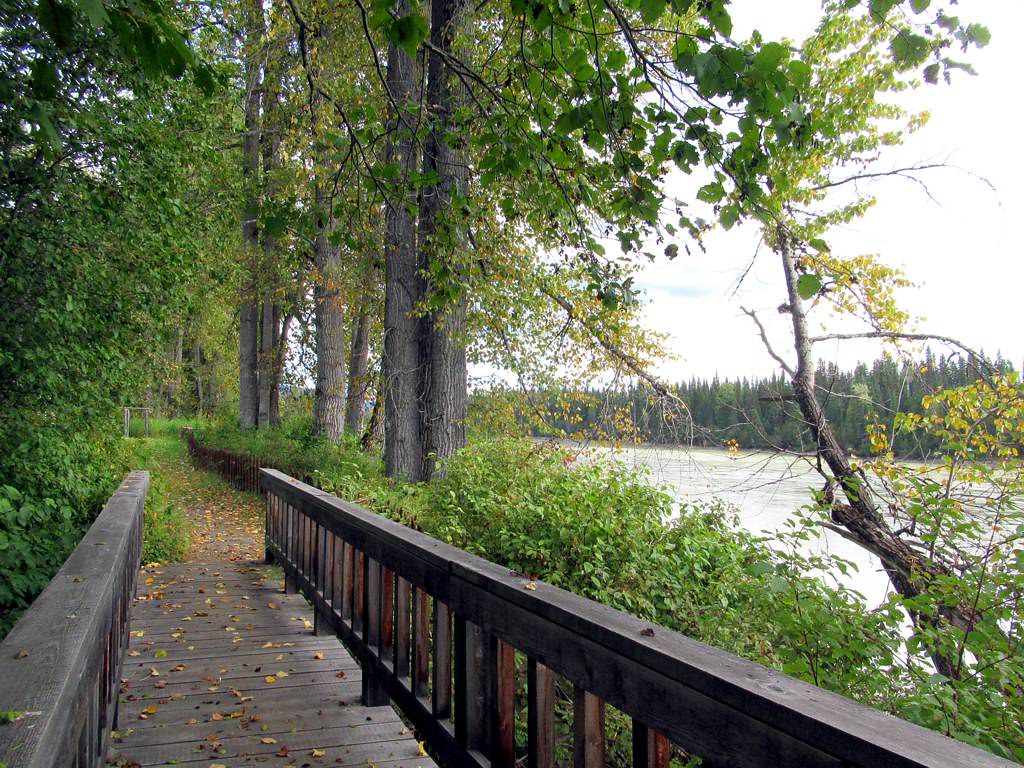
On the opposite side of the Fraser, LC Gunn’s established viewing areas offer a wider view. Looking along the river rather than straight across it helps put landings, slopes and settlement into one frame. Follow the public trail and keep back from the cutbank edges.
The cargo was everyday life
Upstream at Huble, Seebach and Huble sold flour, rice and beans alongside clothing, tack and hardware. They traded for furs, freighted supplies and sold produce from their gardens. Their business joined several kinds of movement: a person passing through, goods going farther north, and food grown close to the store.
The household details are especially vivid in the society’s historical store inventory: canning jars, playing cards, ginger snaps, writing paper and snowshoes. They bring the river economy down to a human scale. A shipment was also a letter waiting to be written, a winter job to do or something sweet to take home.
Keep the river in the picture
The railway changed the region’s journeys, but the earlier routes remain a rewarding way to read it. Choose a park walk, add a stop at the museum, or make Huble a separate day. These are connected stories rather than one continuous walking itinerary.
At the end, turn back toward the water for a moment. Think of the white storefront facing it and the house above the former landing. The Fraser is still where it was in those stories. What has changed most is the direction from which we arrive.
Explore the places in this story
Lheidli T’enneh Memorial Park
Public park walk at the former village site.
LC Gunn Park
A separate elevated view of the Fraser from the east bank.
Huble Homestead
Separate drive north for the riverfront trading-site story.
Sources and further reading
- General Store History (opens original source)Huble Homestead/Giscome Portage Heritage Society · Checked
- Our Story (opens original source)Lheidli T’enneh First Nation · Checked
- History of Prince George (opens original source)City of Prince George · Checked
- Howieson Residence Statement of Significance (opens original source)City of Prince George Heritage Commission · Checked
- LC Gunn Park (opens original source)City of Prince George · Checked
- Seebach and Huble Store (opens original source)Huble Homestead/Giscome Portage Society / Community Stories · Checked