Witch's Butter: The Strange Yellow Thing on a Fallen Branch
A yellow jelly fungus can reveal a second fungus, a microscopic encounter and the reason a fallen branch deserves a closer look.
Something that looks out of place
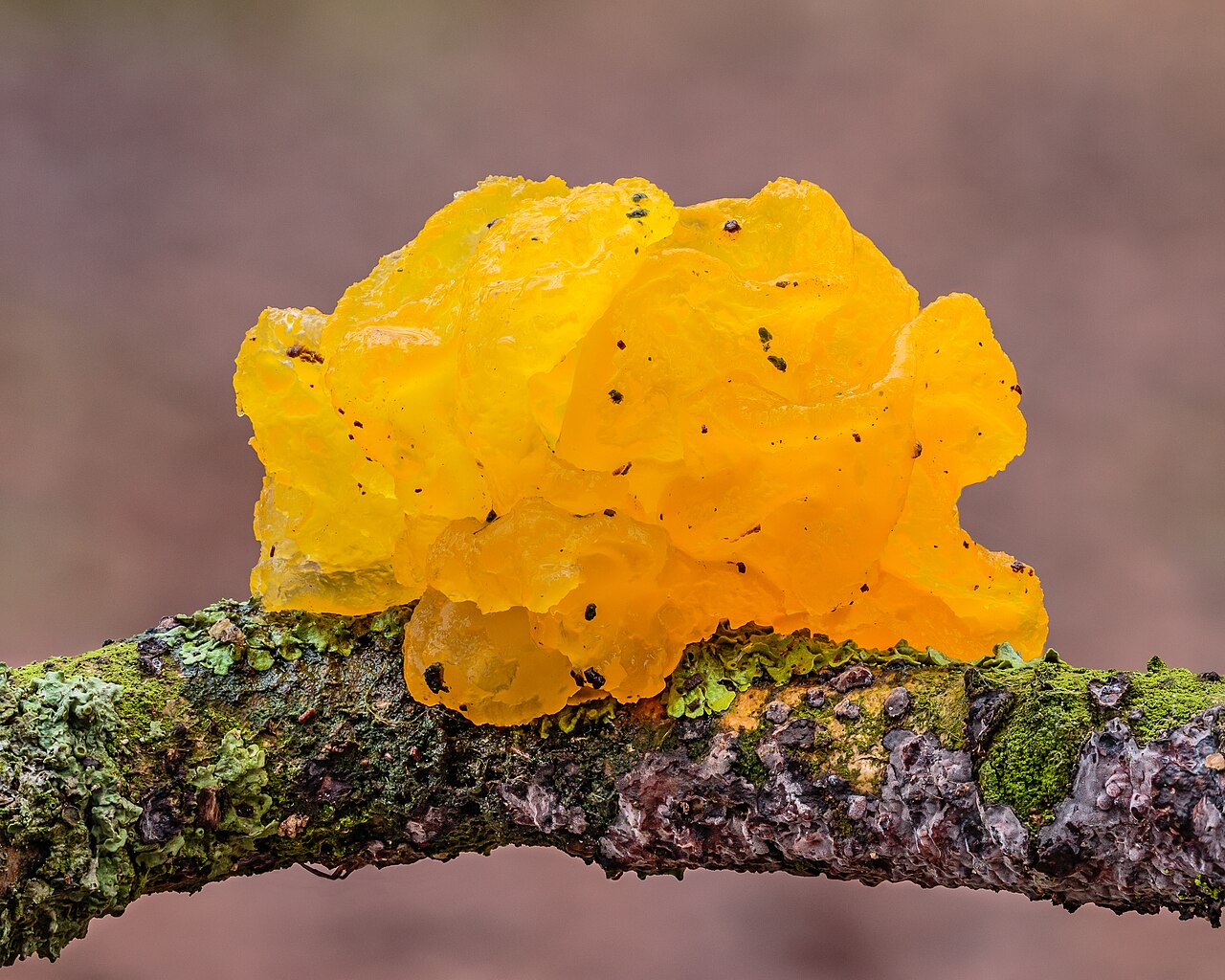
Bright yellow jelly on an otherwise ordinary branch is hard to ignore. Its folds can resemble a small, crumpled sheet of translucent rubber, caught among the muted colours of bark and fallen leaves. Witch’s butter is an excellent name for the surprise. It is also the beginning of a story that extends beyond the yellow lump.
The species usually meant by that name, Tremella mesenterica, is documented in British Columbia. E-Flora BC describes its jellylike fruiting body on hardwood branches and logs. Look closely at what supports it: the branch is the setting for a relationship between two fungi.
Sources: 1
The fungus inside the fungus story
Tremella mesenterica parasitises fungi in the genus Peniophora. That makes the apparent simplicity of a fungus on wood misleading. The yellow organism depends on another organism associated with the branch, rather than fitting the straightforward picture of a mushroom feeding directly on dead wood.
Researchers Walter Zugmaier, Robert Bauer and Franz Oberwinkler examined these interactions with light and electron microscopes. Their 1994 study demonstrated the association with Peniophora laeta and described specialised structures that penetrate the host’s cell walls. A minute pore connects the interacting cells.
A branch that looks uneventful at arm’s length can therefore contain an encounter taking place at a scale far below eyesight. The yellow folds are the conspicuous part of a much less conspicuous life.
Sources: 2
Why the jelly has that shape
The Australian National Botanic Gardens’ fungi guide illustrates the structure beneath the gelatinous appearance: fungal threads and spore-producing cells embedded in a jellylike matrix, with the spore-producing tips reaching the surface. There is no need for the familiar arrangement of a stalk, cap and gills.
That is a useful shift in how to look at fungi. A bracket, a crust and a lump of jelly may look unrelated to the mushroom silhouette on a field-guide cover. Their unfamiliar forms deserve the same attention. Here, the folds are part of a reproductive structure, not a shapeless accident on the bark.
Sources: 3
Yellow is a clue, not a name
Several fungi can produce a yellow or orange jellylike mass. E-Flora BC compares Tremella mesenterica with Tremella mesenterella, whose distinction involves spore shape, and with Dacrymyces chrysospermus, a fungus associated with conifer wood.
An identification photograph should therefore include more than an attractive close-up. Photograph the whole branch and its bark, then the point where the fungus meets the wood. Note whether the branch came from a broadleaf tree or a conifer if you can establish that. Keep an uncertain identification uncertain; a convincing colour match cannot supply the microscopic details.
A name opens the right biological story. Identify a different yellow fungus and the branch may hold a different relationship, with another source of food and another set of microscopic connections.
Sources: 1
Where the witch enters
In his October 2000 fungus essay, mycologist Tom Volk recounted an eastern European folk belief that witch’s butter appearing at a house entrance signalled a spell. That is an attributed piece of folklore, rather than evidence that every community attached the same meaning to the fungus.
The name captures how unsettling an unfamiliar living thing can seem when it turns up on something familiar. A gate, a branch, a fallen log: ordinary surroundings make the yellow growth more striking.
Sources: 4
Keep the branch in the picture
On a forest walk, the best response may be to stop and look without moving anything. Frame the fungus, then widen the photograph until the branch and its surroundings return. The broader view is less theatrical, but more revealing.
The yellow patch has led from a fallen piece of wood to another fungus, and from there to an interaction between individual cells. The common name supplies the Halloween atmosphere. The biology supplies the stranger story.
Sources: 2
Sources and further reading
- Tremella mesenterica: E-Flora BC (opens original source)University of British Columbia · Checked
- Mycoparasitism of some Tremella species (opens original source)Walter Zugmaier, Robert Bauer and Franz Oberwinkler, Mycologia, 1994 · Checked
- Jelly fungi and wood-ears (opens original source)Australian National Botanic Gardens · Checked
- Tom Volk's Fungus of the Month, October 2000: Witch's butter (opens original source)Tom Volk, university-hosted mycology essay · Checked