Before Prince George Was Prince George: The Rival Townsites That Wanted the Railway
A hundred-dollar lot, a newspaper feud and three competing visions of the future explain why the city’s beginning was anything but inevitable.
Ten dollars down on a future city
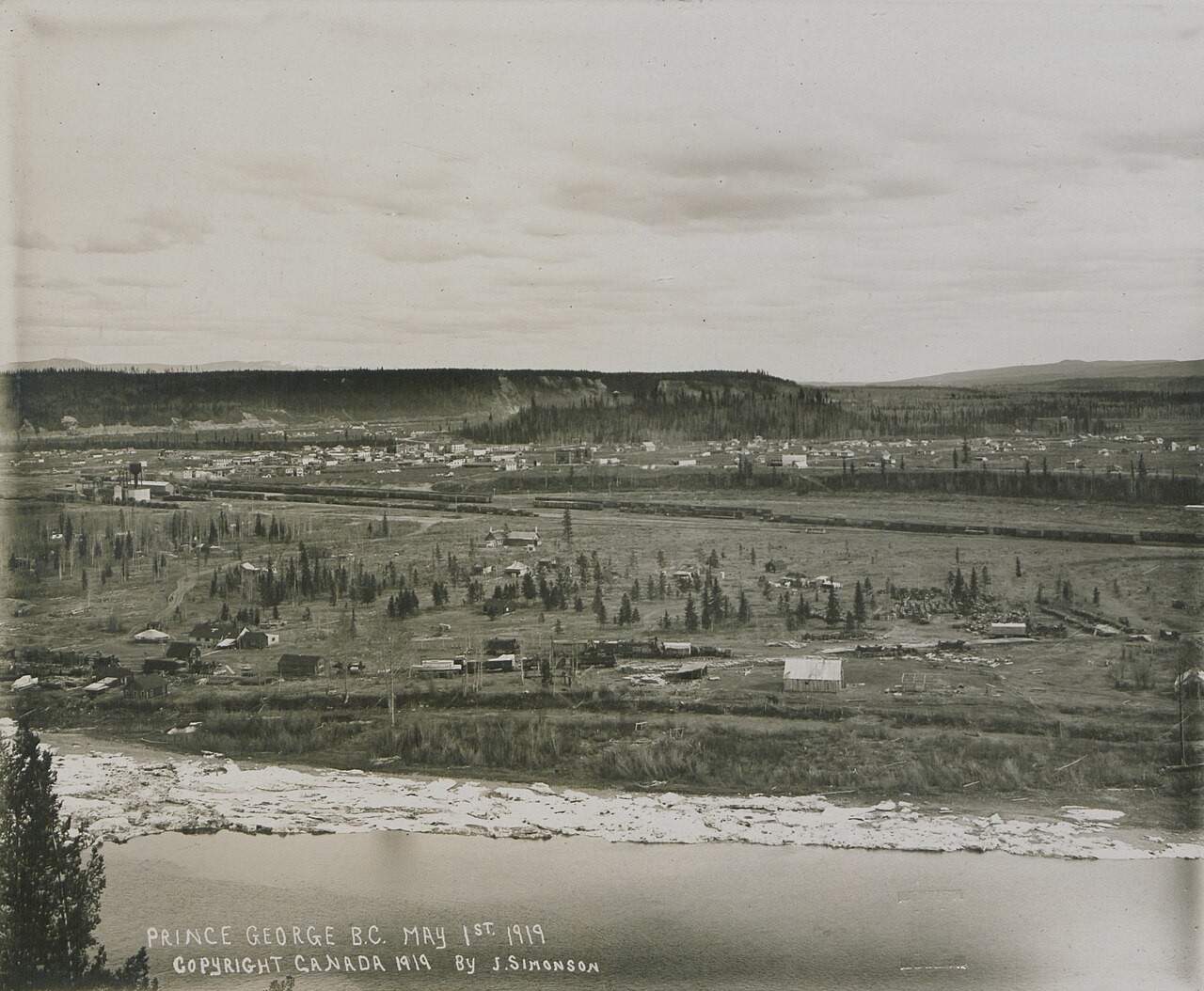
In October 1909, George Hammond’s company offered the first 890 lots in Central Fort George for $100 each, payable with $10 down and monthly instalments. Buyers were being sold a place in a city that promoters expected the railway to make prosperous.
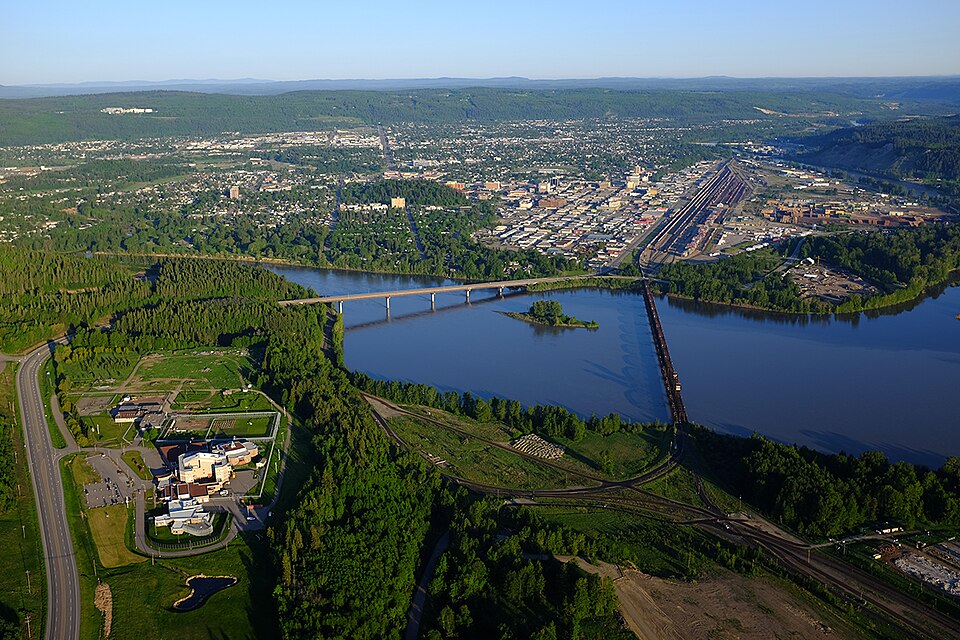
It is a startling way to look at a familiar map. The neighbourhoods of modern Prince George were once competing bets. A railway station could direct newcomers, trade and attention toward one townsite and away from another. The location mattered enough to inspire extravagant advertising and prolonged hostility.
But the maps and advertisements were being laid over an already inhabited homeland. The contest among settler promoters was one part of a much larger transformation at the meeting of the Fraser and Nechako rivers.
Two towns waiting for the same opportunity
South Fort George and Central Fort George were backed by different investment groups. The Northern Development Company registered plans for South Fort George in 1909 and 1910. Hammond’s Natural Resources Security Company promoted the competing central townsite. Both sought to turn the approaching Grand Trunk Pacific into a foundation for growth.
A map of the period makes the rivalry unusually clear. The townsites occupied separate pieces of the landscape, with the reserve between them. They could share the name Fort George while offering investors quite different locations.
That distinction is worth carrying into a walk today. Familiar names can make the past look tidier than it was. There was no single, universally agreed centre waiting for a railway to arrive and confirm its importance. The location of that centre was the argument.
Sources: 2
The argument reached the printing press
The newspapers joined the fight. Hammond gained control of the Fort George Tribune, which promoted his company’s interests and traded attacks with John Daniell’s Fort George Herald. Historian Jonathan Swainger’s account follows a dispute in which local news, land promotion and personal abuse became thoroughly entangled.
A newspaper was a particularly useful weapon when some potential buyers were far away. It could make a place seem busy, promising and inevitable to someone who had never stood there. The same page could also make a competing townsite seem a disastrous investment.
Read those rival visions against today’s city and the certainty dissolves. Streets now travelled without a second thought once belonged to futures being argued into existence. The promoters could advertise confidently; they could not all determine where the station would go.
Sources: 1
A third townsite, and a community forced away
The railway pursued a townsite of its own. Its acquisition of Lheidli T’enneh reserve land created the basis for the new Prince George. The railway’s property gave it a direct financial interest in where development would concentrate.
For the Lheidli community, this was the loss of home. The village was destroyed in 1913 and people were forced to leave. The cemetery remains a connection to the original village within what is now Lheidli T’enneh Memorial Park. Lisa Krebs’s research, hosted by the Nation, records how the loss of the village continued to shape people’s experience of the city generations later.
The railway rivalry is often told as a colourful competition among ambitious businessmen. Standing near the former village changes its scale. One group was trying to decide where a new city should flourish; another was being displaced from a place to which it already belonged.
The new name took hold
The first train arrived in 1914. Prince George incorporated the following year, with its initial boundaries excluding both Central and South Fort George. The library’s historical walking tour records the vote on the city’s name: Prince George defeated Fort George by 153 to 13.
That is a small but satisfying detail in a story full of overlapping names. A question that now seems settled enough to be printed on every road sign was once put to a ballot.
The new centre did not erase every trace of the earlier towns. It absorbed people, businesses and, over time, surrounding neighbourhoods into a larger urban story. What had been competing destinations became places within the same city. Their rivalry survives most clearly when the modern map is allowed to separate back into its earlier pieces.
A surviving address
The Munro/Moffat House provides one particularly tangible connection. Built in 1914 in Central Fort George, the log residence stands at 153 North Moffat Street. Its successive owners included two bankers, John Munro and Alex Moffat. The house is a reminder that these places contained actual households and investments, not only speculative lines on paper.
Treat it as a private home to appreciate from the street. Then look again at the city around it. Downtown, South Fort George and the Crescents can seem like inevitable parts of a single place. Their history is full of choices, pressure and competing expectations. A walk through Prince George becomes more interesting when those alternative futures are allowed back into view.
Sources: 6
Explore the places in this story
Lheidli T’enneh Memorial Park
Former Lheidli village site and essential historical context; respect the active cemetery.
Duchess Park and the Crescents
A separate outing within the former railway townsite, not a direct trail connection to the other places discussed.
Sources and further reading
- The Notorious Georges: Crime and Community in British Columbia’s Northern Interior, 1909 to 1925, excerpt (opens original source)UBC Press and the Osgoode Society, Jonathan Swainger · Checked
- Case. Prince George: Planning for Low Growth (opens original source)Land Use Planning and Policy in British Columbia, BCcampus · Checked
- Reclaiming Lheidli: Towards Indigenous Planning in Prince George (opens original source)Lisa Krebs, hosted by Lheidli T’enneh First Nation · Checked
- Hello, let’s talk about a park (opens original source)Andrew Kurjata · Checked
- Historic Downtown Walking Tour, June 2013 (opens original source)Prince George Public Library · Checked
- Heritage Register and Properties (opens original source)City of Prince George · Checked