Teapot and Coffeepot: The Volcanic Remains North of Prince George
Two familiar hilltops north of Prince George reveal volcanic plumbing, cooling fractures and fragments carried up from beneath the landscape.
Mountains with something missing
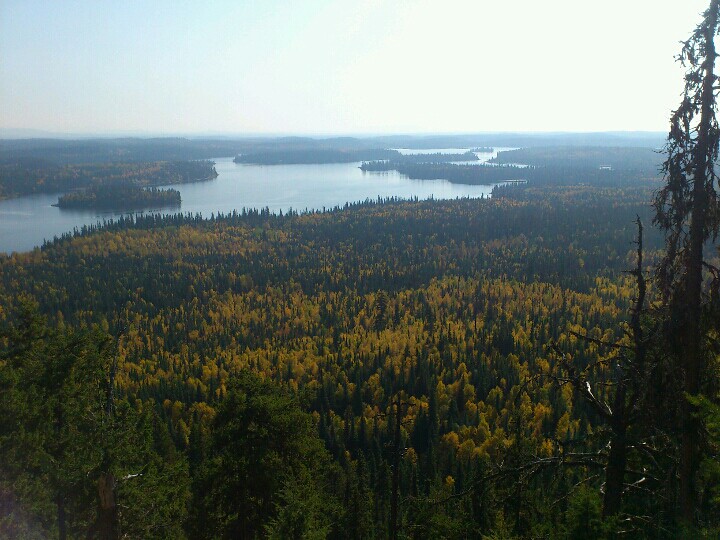
The names suggest a pair of kitchen objects. The rocks suggest something much larger has disappeared. Teapot Mountain and Coffeepot Mountain, north of Prince George, are identified in Geological Survey of Canada research as volcanic necks: remnants of passages through which molten rock once moved.
The hilltop is a glimpse inside a volcano. Erosion has removed much of the surrounding structure, leaving solid rock where magma once travelled.
Sources: 1
Inside a volcano
A volcanic neck forms when material solidifies within a volcano’s conduit. Over time, erosion can strip away the surrounding rocks and leave that harder core standing in relief. Geologists also use the term volcanic plug for these features. Neither term means an intact crater waiting at the top.
This is an example of a landscape revealing what used to be underground. The shape visible today combines two histories: the volcanic activity that placed the rock there, and the much longer work of removing material around it. Height alone does not tell you how large the original volcano was. Nor does a circular walking route prove that it follows a former crater rim.
Sources: 2
The geometry of cooling
Columnar joints are another useful clue. As hot rock cools and contracts, stresses build until it fractures. Under suitable conditions, those fractures divide the rock into elongated columns. A cross-section can resemble a collection of polygons fitted together.
The columns need not be perfect hexagons. Cooling conditions vary, and so do the cracks. Their direction relates to the surfaces from which heat escaped, which is why columnar rock can stand upright, lie sideways or curve in different volcanic settings. The striking geometry is a physical record of cooling, rather than evidence that someone cut and stacked the stone. Notice the pattern from the established route; a cliff base is no place to linger for a closer inspection.
Sources: 3
A rock can carry another rock
The Canadian survey records xenoliths in these volcanic rocks, including samples from Coffeepot. A xenolith is a fragment of pre-existing rock incorporated into a different host. Rising magma can carry such fragments towards the surface.
Their minerals and textures offer researchers clues to rocks otherwise hidden underground. An apparently uniform lump of basalt can carry pieces of another geological story. Recognizing those pieces takes care: a pale fleck alone is not enough to identify a xenolith.
Two places, two outings
Teapot and Coffeepot belong together geologically, but each needs its own route plan. The Caledonia Ramblers describe Coffeepot’s outing as approximately 2.5 kilometres including its upper loop, and reported clearing to the top in May 2026. Their approach uses several forest-road junctions, with a previously missing junction sign noted separately from the trailhead marker.
Teapot has its own official recreation-site listing. Use that listing and the current Northward guide to check access, especially while trail work changes the available route. A photograph of an open path from a previous summer is not a current road or construction notice.
Look back at the hill
Look back at the hill after the walk. The missing material is part of the view now: the rock that once surrounded the neck, and the volcano whose interior is exposed.
Teapot and Coffeepot make you imagine a landscape both above and beneath the one beside the road.
Sources: 2
Explore the places in this story
Teapot Mountain
Check current access and route work before choosing an outing.
Coffeepot Mountain
A separate approach and walk; do not transfer Teapot directions to this route.
Sources and further reading
- Targeted Geoscience Initiative: 2017 report of activities, Volume 2, Open File 8373 (opens original source)Geological Survey of Canada · Checked
- Volcanic Necks and Plugs (opens original source)US National Park Service · Checked
- Columnar jointing provides clues to cooling history of lava flows (opens original source)US Geological Survey · Checked
- Clues to Mauna Loa’s plumbing system (opens original source)US Geological Survey · Checked
- Coffeepot Mt. (opens original source)Caledonia Ramblers · Checked
- Teapot Mountain recreation site (opens original source)Recreation Sites and Trails BC · Checked